How to interpret Odds in Bets- Feb, 2021 -
Omaha poker is one of the most popular poker variants. For many poker players who start out learning to play Texas Hold'em, Omaha is often the next game they learn to play, basically because Omaha is somewhat similar to Hold'em in the way it is played.
There are different types of Omaha variants, the most popular being pot-limit Omaha (which we will focus on) and Omaha hi-lo.
If you know the rules of Texas hold'em, you are halfway through knowing how to play Omaha. However, let's first focus on the differences between the two games.
Like hold'em, Omaha is a "flop" game that uses community cards. As in hold'em, players are dealt their own cards face down, their "hole cards", and must use those cards by combining them with the five community cards (the flop, the turn, and the river) to make the best hand. of five cards. However, there is a big difference between Omaha and hold'em.
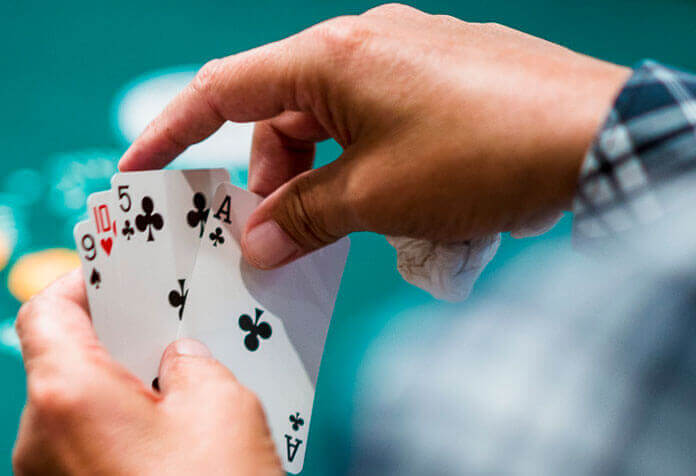
While in hold'em players receive two cards or hole cards, in Omaha four cards or hole cards are dealt to each player.
Of these four cards the players must choose two, and, combined with three cards from the five community cards, form the best five-card hand. It is necessary to bear in mind that this is also a substantial difference between the rules of Omaha and Hold'em.
In Omaha, players must inevitably use two of their cards and three of their community cards to complete a poker hand.
That makes it different from hold'em, where players can use their two hole cards (and three community cards), just one card (and four community cards), or none of their cards (and use all five community cards, which is called " play with the table ").
Beginning players who know little more than the rules of Omaha often make mistakes when it comes to building a five-card hand, mainly because they forget the rule that you must use two of your four hole cards and three community cards to build your hand.
For example, a new player who has A ♥ Q ♣ 7 ♦ 6 ♦ may face a 9 ♥ 4 ♥ 2 ♣ J ♥ Q ♥ and think that he has the nuts after making a maximum flush. The problem is that you can't make a hand using just one of your own cards (in this case the A ♥) and four community cards (the four hearts on the board).
In fact, this player has only one pair of checkers, in no case color. Meanwhile, any player with two hearts would have a flush, which means that our protagonist should fold this hand before any bet on the river.
Betting in Omaha works exactly as it does in Texas hold'em, with a small and big blind, a rotating button, and four rounds of betting after each deal: preflop, flop, turn, and river.
Pot-limit Omaha (or "Omaha high") is known for being an "action game", and that is why it is so popular with high-stakes players. Since in Omaha players start with four cards instead of two, they can complete a greater range of hands. For this reason, as a general rule, the value of the hands is usually higher in Omaha than in Hold'em, and players tend to make the "nuts", or maximum possible hand, more frequently.
If you think about it, in PLO players not only receive a two-card combination (as in hold'em), but they have six different two-card combinations (among the four hole cards) from which to choose the best one. Therefore, it is not surprising that players tend to have better hands at showdown when playing Omaha.
In Texas Hold'em, two pair or three of a kind can be a very strong hand, but in Omaha there will often be better hands to beat plays like these.
For example, let's say you've received 10 ♠ 9 ♠ 8 ♥ 7 ♥ and that on the river the board is 7 ♠ 9 ♥ K ♥ J ♣ 2 ♦. Using the ten and eight from your hand, along with three of the community cards, you have a straight to the jack. The problem is that any opponent with a hand like Qx10xXxXx could have completed a straight to the king and beat you, and if the betting gets tough on the river that's probably what is happening.
Another example might be a hand like J ♠ J ♣ 9 ♠ 9 ♥ on a board 9 ♦ K ♠ Q ♥ 5 ♦ 3 ♦. Yes, you have a set of nines, which could be a good hand in Texas hold'em, but in Omaha there will be several hands that can beat you here. Anyone with KxKxXxXx or QxQxXxXx will have a bigger set, and an opponent with Jx10xXxXx could have completed a straight. There are also color options, which means that anyone with X ♦ X ♦ XxXx (two diamonds) could have completed color.
Due to this high probability of better hands, some players may only call us with pairs of kings or queens, as they may fear possible straights or flushes, which means that even when our opponents limit themselves to calling we could be losing. hand, so it is important to be cautious.
Another factor that needs to be considered when discussing Omaha rules and playing the popular pot-limit version of Omaha is the pot-limit betting format, which is another way in which PLO differs from no-limit Hold'em.
As in Hold'em, the minimum bet allowed is always the size of the big blind. For example, if we are playing € 1 / € 2 PLO, the minimum that a player can bet would be € 2. However, while hold'em is usually no limit, so a player can bet all of his chips at any time, in Omaha the maximum bet allowed is the size of the pot. Calculating exactly a "pot size" bet can be a lot more complicated than it first appears. If the pot is € 10 and the player is the first to act, € 10 is the maximum bet the player can make, that's pretty simple. However, if there has already been a bet and a player wishes to "pot" this can be a bit more difficult.
Let's say there is € 10 in the pot and one player bets € 5 before another player wants to bet the pot. The maximum that you can bet would be € 25, a total that is added by adding the € 5 of the call plus the € 20 that should be in the pot after the call (€ 5 + € 20 = € 25).
In fact, preflop the blinds are considered forced bets, so once again, we will have to resort to math to determine how much a player can raise even if they speak first. In a € 1 / € 2 PLO game, the maximum amount a player can open the pot with is € 7. That total is achieved by adding € 2, or the equivalent of the big blind, to the size of the pot after the big blind has been called (€ 2 + € 5 = € 7 in this case).
When you play at a casino, the dealer will take care of the calculations for you in case you announce that you want to bet the pot. When you play online poker, the calculations will automatically be found on the screen.
As in hold'em, position is an important element in Omaha. Many consider it even more important due to the pot-limit format and the multiple combinations that players can complete with an Omaha hand. When you have position, you will be able to know the action of your rivals and make your decisions based on the information you have received. When you are out of position, it is much more difficult to make correct decisions because you will find yourself with incomplete information more often.
Another benefit of playing position is that you have a better chance of controlling the pot, something that interests you based on the strength of your hand and your goal in that particular pot. Being out of position against one or more opponents gives them the opportunity to control the size of the pot and to know your actions in advance.
Because Omaha is a game that is focused on the best hand, it might seem that bluffing could play a role. A player can represent a greater range of hands in Omaha, and also speculate a bit more with the possibility of more semi-bluffs. In fact, more experienced Omaha players tend to bet their draws heavily on the flop, as in some cases those draws will be mathematically favorites even against made hands.
What this means is that players bluff in Omaha, but with so many possible hands, you have to be very cautious in deciding when it is best to bluff. The more you learn about the game, the easier it will be for you to understand these spots and determine how to proceed against various opponents.
In relation to this, it is also much more common to have blockers in Omaha than in Hold'em. Blockers are those cards in your hand that prevent your opponent from completing a specific hand.
For example, if on the board there is K ♠ 10 ♠ 5 ♥ 2 ♦ 4 ♦ and you have an A ♠ in your hands, but no other spades, you have no color, but you know that your opponent cannot have the maximum color. That gives your hand extra power, and can allow you to knock your opponent down from certain hands, since he knows for sure that he doesn't have the nuts.
Omaha is a game of action, but it can also be a game of big swings. Many players learn Texas Hold'em before they start playing and learning the rules of Omaha. Knowing the basics of Texas Hold'em well goes a long way in making the transition to Omaha.
Give us your opinion is very important.