Introduction to Pot Limit Omaha High / Low- Feb, 2021 -
It is a form of community card poker, like Texas Hold'em, in which the maximum bet limit is determined by the size of the pot at the time.
Each player receives 4 cards that only he sees in the phase called preflop. In the center of the table there are 3 cards in the phase called the flop, one more in the phase called the turn and another one in the so-called river. The 5 cards thus arranged in the center are community cards, which all players can use to form their hand.
There are bets after each of the four phases, in which players can bet, raise a previous bet from another player or fold and, as we have discussed previously, in the Pot Limit variant the maximum bet is determined by the size of the boat at that time.
In Omaha, therefore, we have four cards in hand that only we can see, and five cards on the table that everyone can use. However, not just any combination of them is valid. An Omaha hand must be made up of two (and only two) of the four cards in our hand in combination with three (and only three) of the community cards.
Pot Limit Omaha is a very fun game, in which you usually see a lot of action and in which you have to be quite careful in general. It is advisable to have between 20 and 30 times the amount with which you enter the table to be able to play freed from the stress of having to decide, many times, whether to bet all your rest on a hand with great potential. In this game there are many situations that are difficult to solve, but on the other hand, it is also relatively easy to count the cards that, if left, will give you victory, study the probability of this happening and, therefore, make decisions with predictably expectation positive.
Before the flop, hand selection is very important. Any set of four cards dealt to us can become a winner, that's true, but only combinations in which all four have some interrelation with each other have a high enough probability of this happening to become winners in the long run.
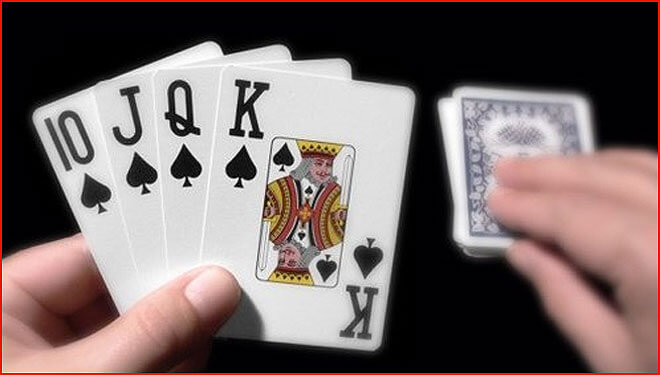
In general, we will look for these types of letters. Hands like AAKQ, KQJ9, 8765… in the different situations in which they can be played, they are what we are looking for.
Regarding aggressiveness in this phase, it depends on the table and our ability to play after the flop. No hand is good enough to win on its own (this truth is much more unanswerable in Omaha than in Hold'em), so the effectiveness of raising before the flop against unselective tables, or when we are not very solvent in the phases later, is, to say the least, debatable.
On the flop it happens that we know a very large percentage of the total information that we will have at the end. In this phase, the biggest decision to make is whether we will continue in the hand or we will fold. Basically, we will fold as long as we don't have a hand that has a sufficient probability of winning. From the betting patterns of the opponents before the flop and on the flop, we can more or less estimate the hands we are facing, and calculate precisely how many cards we will use to complete a winning hand.
For example, if our hand is As9s8h7h and the flop comes 6s5sKc, we can estimate that there are 17 cards that, if drawn, would complete a winning hand for us (4 fours, 3 sevens, 3 eights, 3 nines and 4 spades). We do not count the Ks, because in that case our move would be completed, but we could not be sure that it was a winner.
With 17 "winning" cards our hand is very strong and, if we play it aggressively at this point, we can even get people to fold before it is even completed, or get all our money to end up in the middle and see like this. the two remaining cards and not having to make complex decisions on the turn if our hand is not completed by then.
There is a universal truth in Pot Limit Omaha exploited to the extreme by many players: you can bet or raise with almost any hand, since it is relatively easy for someone to have the best possible hand at any time, but to see a bet you need to have the best hand or be sure that the opponent does not have it, which is quite complicated. This idea is most valid on the flop.
On the other hand, the structure of Pot Limit makes this phase not the best to protect our “made” hands (such as the highest three of a kind) on flops with a complicated texture (connected cards and two of the same suit , for example). Therefore, we will also have to make complex decisions and find a balance in the bets to be made in this phase to try to protect the best “temporary” hand (without offering to see cards for free to opponents) but without risking too much in case of have opponents complete their projects.
The turn is the phase in which the best “temporary” hand must protect itself. A pot-sized bet in this phase, coupled with the fact that there is only one card left to come out and complete potential projects, means that none of these projects has a mathematical justification to call the bet, no matter how dangerous the cards on the table are. .
The only exception to this point is the situation in which we believe that an opponent also has the best temporary hand, like us, and also an improvement project. Suppose we have 9h8s7c6d and the table contains 10h8h6cKc. If another player has QhJc9c7h or KhKs9c7h it is evident that betting on the turn has a negative expectation, since if our straight holds we will only split the pot with the opponent, and if any of their projects is completed we will lose everything.
However, if the table is very aggressive many of the time the money will be in the center on the flop, and the turn will be a mere paperwork.
On the river, we already have all the information. Our hand is formed, complete or not as the best possible, and we can almost certainly estimate the hand of the rivals. Therefore, in this phase what it is about is to get as much extra money as possible, in the event that we have the best hand, and to decide whether or not to fold in the event that we do not have it, depending on what do the opposites and what we think they carry. It is also a good time to bluff if the betting patterns are consistent, and to be bluffed and detect such bluffs based on those patterns and other information that we may know from the opponents (notes, gestures, way of being).
Do we bet the pot or just a part? If your opponent bets the pot, is it bluffing or does it have the best play? Why would I bet the maximum if he has the best play, risking that I fold, if with a smaller bet he could force me to call? But on the other hand, what if he's bluffing, and he knows I'm thinking this myself?
Well, no one said making these decisions was easy. But that is the essence of poker.
Give us your opinion is very important.