
Elements to consider when betting on horse races- Feb, 2021 -
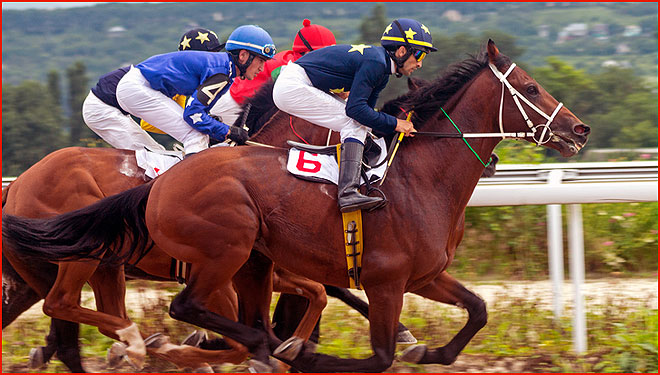
Riders are heavy before and after a race. The racehorse has a bridle, a mouthpiece and reins. The saddle is quite light and specially designed for this sport with the skirts facing forward. Additionally, there is a collar or bib.
It certainly doesn't look like it. On average, 24 horses die each week at US racetracks!
One study on racetrack injuries found that every 22 races, a horse sustained an injury that prevented it from finishing the race, and another study estimated that three thoroughbreds die every day in North America from terrible injuries sustained during races.
Trainers and veterinarians keep injured horses working when they should be recovering - giving them a variety of medications to mask pain, control inflammation and improve performance.
Blasi: So I put them this way: “It's very simple. If you want the job, you will not work for me under that name. "
An undercover PETA investigation found that Thoroughbred trainer Steve Asmussen allegedly forced employees from other countries to use false names and gave them fraudulent Social Security cards. Asmussen has incurred multiple violations of drug regulations and has been suspended for violations.
One horse, Nehro (who finished second in the 2011 Kentuky Derby), was forced to run with chronic pain in his hooves that actually had holes in them - and one of which was stuck with 'pegaloca'. He died after becoming severely ill.
It is not true. Many end up in slaughterhouses in Canada, Japan or Mexico, where they are made into dog food and glue. Its meat is also exported to countries like France and Japan, where it is considered a delicacy - yuck!
Of course there is! Shortly after PETA released its video documenting drug misuse and other abuses at Churchill Downs and Saratoga racetracks, by Steve Asmussen and other employees of their stables, the horse racing authorities in Kentuky and New York and eight others. Federal and state agencies announced that they are initiating formal investigations and Asmussen is no longer considered for the Racing Hall of Fame. Other significant reforms have also been announced.
Horse racing, well known as the "sport of kings" has been carried out for many centuries. Here we give you a brief history of its origin, modalities, horses, riders, tracks, etc .; everything you need to know.
Source
Perhaps its origin is older but the most famous racing shows occurred in the Roman Empire (27 BC - 476 AD). The horses pulled carts where a driver was going and made several laps around the circus, encountering certain obstacles that they had to avoid.
At present, the love for horses is very widespread, so we can find horse races in many cities around the world.
Types of horse racing
There are several types of races, so we will classify them according to 5 parameters:
Gallop horse racing (turf)
The most prestigious and far-reaching competitions in the world of horse racing are those that take place on racetracks, with saddle horses, at a gallop and on a flat track. Races in Great Britain, Ireland, France, the United States, Australia, Hong Kong and the Middle East are particularly popular.
Horse races are held in a closed way: between horses of the same age, sex or breed, or in an open way: different age, sex or breed.
The basis weight that a horse must carry depends mainly on the age of the horses to which the race is open. Some races allow surcharges or discharges to this base weight, considering several factors such as the horse's participation in other tests, the prizes obtained, or the category of the rider's license.
The handicap
It is a race in which it is about equalizing the chances of winning for all participating horses. The usual races are carried out on routes of 1000 to 1600 meters and the Grand Prix on routes of 1600 to 2500 meters.
In several countries there is a very special and difficult achievement, called the "Triple Crown." Recognition in this event is given to those who have won 3 of the most important races in their country in the same year, in the 3-year category.
What are the most outstanding races in the world?
Derby to many outstanding races and with greater economic prizes anywhere in the world are denominated. Regarding smooth track racing, among others, the most important are:
The race horse
More than 90% of the horses that participate in the races are Purasangr, as it is a breed that is characterized by having fast and resistant "galloping" specimens. The thoroughbred is a breed of horses that develops earlier, that is why horses between 2-4 years old normally participate, the younger ones being the least demanded in terms of distances.
Give us your opinion is very important.